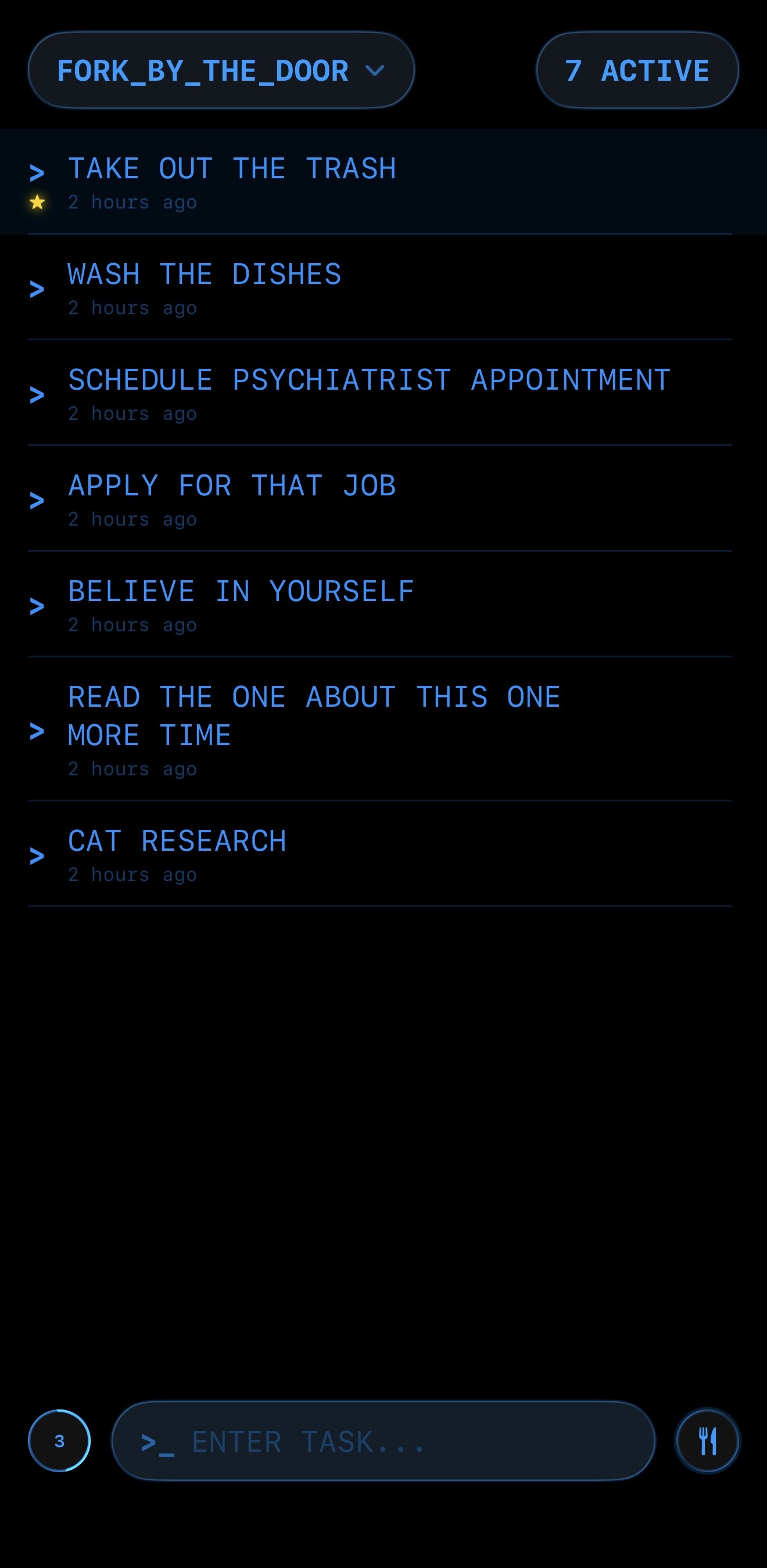
A persistent capture system for ADHD brains that can't stop what they're doing
VRChat's New User Problem
An interaction design teardown of why new players bounce off VRChat before they find what makes it worth staying for
Five years at Apple gave me a perspective you don't get from most design jobs. I watched hundreds of real people struggle with real interfaces, and I built things end to end to fix them. I notice broken workflows, design the fix, and build working prototypes to prove the idea using AI-assisted development. Based in Seattle. Open to what's next.
Open to full-time roles in interaction design and design technology.
Case Study
Fork by the Door
A persistent capture system for ADHD brains that can't stop what they're doing to write something down.
Role
Interaction Designer
Platform
iOS
Type
Personal Project · 2026 — Present
The Problem
Forgetting isn't the problem. The timing is.
The thought arrives when you're in a game. Or a meeting. Or a conversation that needs your full attention. You can't stop what you're doing, but if you don't capture it right now, it's gone. You tell yourself you'll remember. You don't.
My workaround was asking Siri to remind me in 5 seconds — just enough delay to fire a notification while the thought was still fresh. It worked, barely. But notifications disappear. One swipe, one other alert, and it's gone. For an ADHD brain using that notification as an external anchor, gone means actually gone. The thought doesn't come back.
Apple Reminders added a persistent display feature in December 2024, but it requires setting an alarm time in advance. That's the wrong model. When you're in flow, you don't know when you'll be free. You just need the thing to stay visible until you are.
Fork by the Door is built for that gap.
The Interaction Model
Capture in under two seconds. Stay visible until you're ready.
The core loop is simple: capture fast, stay visible, disappear only when you decide it's done.
Capture had to be as fast as possible. The input bar lives at the bottom of the screen, always. One tap and you're typing. Hands busy? Mid-game? You trigger it with Siri — "Fork by the Door, fork this" — and the task goes in without you ever unlocking your phone.
Once a task exists, it doesn't go anywhere. It lives on the lock screen as a Live Activity. Persistent. Ambient. You can't accidentally swipe it away. It's there when you wake your phone to check the time. It stays until you say it's done.
iOS only allows one Live Activity on the Dynamic Island at a time. Which task gets the slot? I went with the oldest active task — the one that's been waiting longest, most likely to have been forgotten. You can override it with a star. Something more urgent just came in? One tap promotes it. The default logic is grounded in how ADHD forgetting actually works. The override is for when reality is more complicated than the default.
Interaction flow — coming soon
The Gesture System
Every interaction maps to something the user already knows.
Full swipe left dismisses the task and grants XP. It's the same motion as archiving an email, clearing a notification, deleting a message — a gesture that already means "this is handled" in your muscle memory. No new behavior to learn. The reward fires at the moment of completion, not behind a confirmation dialog.
Half swipe reveals the three-dot menu. Secondary actions appear only when you reach for them. The primary experience stays clean.
Scrolling down collapses the input bar — the same way Safari collapses the URL bar when you scroll. When you're reading you need vertical space. When you're adding you need the input. The interface adapts to what you're doing without you ever switching modes manually.
Gesture demos — coming soon
The Reward System
Filling in for something that's actually missing.
ADHD brains aren't motivation-deficient. They're reward-deficient. The dopamine response to completing a task is genuinely weaker. External reward systems aren't just fun — they fill in for something that's actually missing neurologically.
That's what the XP system is for. Complete a task, earn XP. Complete it fast, earn more. The system rewards action over inertia, which is one of the core failure modes the app is built around.
Future versions will cap active tasks before new ones get locked out. This is intentional. There's a specific ADHD failure mode where you pile tasks into a list, feel temporarily better for capturing them, and then watch that list become its own source of anxiety — another thing you're failing to do. The cap prevents the tool from becoming the problem.
Case Study
VRChat's New User Problem
An interaction design breakdown of why new players don't survive their first hour in VRChat, and what would fix it.
Role
Interaction Designer
Platform
PC · Meta Quest
Type
Design Teardown · 2026
The Problem
VRChat was built by the people who already survived it.
VRChat was built by and for people who already know how to survive it. Five years of organic growth created a platform with real depth: game worlds, social spaces, content viewing rooms, creative communities. Nobody ever came back to redesign the front door.
The result is a platform that works beautifully for its existing community and is nearly impenetrable for everyone else. The shrieking children, the screen-filling avatars that crash your game, the people spamming profanity. Those aren't bugs. They're what happens when a platform optimizes entirely for power users and never asks what a new person needs on day one.
VRChat has the infrastructure for something genuinely special. A social platform where identity, expression, and presence are the whole point. But right now you only get to experience that if you're lucky enough to find someone patient enough to explain it to you.
I wasn't lucky the first time. The second time I was. Most people don't get a third.
Problem 1 · No Orientation
You spawn into chaos with no orientation.
Your first moment in VRChat is a small room with a mirror and a handful of free avatars. It feels like a waiting room. Click past the first few pages and everything costs virtual currency a new player doesn't have and doesn't understand yet. The platform's answer to "who do you want to be" is a storefront you can't afford.
VRChat does have a mandatory tutorial for brand new accounts. It covers movement, the menu, interacting with objects, and safety settings, and it runs before you're dropped into the main social hubs. Mine never played. I made my account five years ago and only started actually using it now, so as far as VRChat is concerned I was never new. There's no way to ask for it again. No settings toggle, no replay option. If your account is old enough, the platform assumes you already know what you're doing, whether you remember any of it or not.
That's not an edge case. Anyone who lapses and comes back hits the same wall. And even the players who do see the tutorial only get taught how to move and open a menu. Nobody tells you that there are entire categories of worlds you haven't found yet, that the avatar you start with reads as a placeholder to everyone else, or that a ranking system just started quietly tracking you the moment you spawned in.
Spawn room and starter avatars (coming soon)
Problem 2 · Broken Avatar Discovery
Avatar discovery is a broken system built on top of another broken system.
The official avatar store requires currency. So experienced users learn about free avatar worlds: entire worlds built specifically to browse and try on free avatars made by the community. New players don't know these exist. There's no mention of them in onboarding. You find out through word of mouth or by accidentally stumbling into one.
Avatar store currency wall (coming soon)
Once you're in a free avatar world, the search is nearly unusable. You can search by avatar name or author name only. No keywords, no descriptions, no tags. If you don't know what you're looking for, you can't find it.
Avatar search results (coming soon)
There's no cross-platform preview either. Female-presenting avatars often have jiggle physics on PC that are absent on Meta Quest. You have no way of knowing how you'll appear to players on other platforms before you select an avatar. No warning, no preview toggle, no indication that your avatar might look dramatically different to half the people you meet.
PC vs. Quest avatar comparison (coming soon)
Problem 3 · The Invisible Rank System
The trust rank system is invisible, unexplained, and consequential.
VRChat has a progression system based on hours played and social connections: Visitor, New User, User, and higher tiers beyond that. Your rank determines which worlds you can enter, which features you can access, and how other players' safety settings interact with your avatar.
I found out my rank existed when a bouncer at a world door told me I was a Visitor and kicked me out. I then spent twenty minutes asking people at the entrance of a different instance of the same world what my rank meant and how to change it before someone finally answered.
Trust rank buried in the profile tab (coming soon)
Your rank lives buried in your profile. It's not explained during onboarding. Even experienced players are fuzzy on the exact requirements. It's a core progression system treated like a footnote: consequential enough to lock you out of experiences, invisible enough that you don't know it exists until it's already affecting you.
World entrance with a rank requirement (coming soon)
Problem 4 · Audio That Doesn't Scale
The audio system treats all sound as equal.
VRChat runs on proximity-based spatial audio. The closer someone is, the louder they are. In theory this creates natural conversation. In practice it means the shrieking child twenty feet behind you is competing with the person standing in front of you.
There's a master volume control. There's no spatial audio zone control. You can't shrink your listening radius so you hear the conversation you're in without hearing the chaos around it. The only solution is to lower everyone's volume, which means you can't hear the person you're actually talking to either.
This is the first thing new users experience, and it immediately signals that VRChat is not built for them.
Audio settings panel (coming soon)
Problem 5 · Expression As An Afterthought
Expression and customization are an afterthought on a platform built entirely around identity.
VRChat is fundamentally a platform about who you want to be and how you want to express that. Identity, presence, and self-expression are the whole point. The avatar you choose is your face, your body, your first impression on everyone you meet.
Given that, the customization system is remarkably primitive. Avatars with customizable features (outfit options, color changes, height adjustments) require specific tricks using the expression or emote wheel that are never explained and vary by avatar. There's no unified character editor. No robust system for making an avatar feel like yours rather than someone else's that you're borrowing.
I ended up shrinking down a stranger's avatar and changing the outfit colors because I liked being a little guy and there was no better path to finding something that felt like me. That's not a design solution. That's a workaround.
Most avatars do have a voice visualizer, a moving mouth mapped to your microphone, which is a good baseline. But the gap between Quest users and PC users goes deeper than mouth movement. Quest users communicate through full body tracking: hands, head, torso. PC users are locked to whatever emotes the avatar creator chose to include, which ranges from a handful to none. On a platform where presence and non-verbal communication are the whole point, expression shouldn't be a hardware privilege. A baseline set of platform-level emotes mapped to standard humanoid and quadruped rigs would give every PC user a minimum viable physical presence regardless of what the avatar creator built in.
Emote wheel and hidden customization options (coming soon)
The Redesign
Five fixes, none of them exotic.
Onboarding. Extend the existing tutorial instead of replacing it. Keep the movement and safety basics, but add a walkthrough of world types: game worlds, social worlds, content rooms, creative spaces. Show people what's possible before expecting them to discover it on their own. And let it retrigger for any account that's been inactive long enough to have forgotten everything, not just accounts that have never logged in before. End it in a curated, low-chaos starter world, not a random public one.
Avatar discovery. Merge the official store and free avatar worlds into one unified system. Let community creators list free avatars directly in the store alongside paid ones. Add keyword and description search. Add cross-platform preview so you can see how your avatar renders on PC and Quest before selecting. Add physics toggles. Surface trust rank requirements clearly during avatar selection if they're relevant.
The avatar I ended up with (coming soon)
Trust rank. Surface it during onboarding, explain it clearly, show progress toward the next tier. Make it visible on the main screen, not buried in a profile. When a world has rank requirements, explain what the requirement is and how far away you are before you try to enter, not after you've been kicked out.
Spatial audio. Add a listening radius control separate from master volume. Let users define how wide their conversation zone is. Full volume for people inside your radius, significantly reduced for everyone outside it.
Expression system. Build a unified character editor that surfaces every customization option for a given avatar in one place, regardless of how the creator implemented it. Make it accessible from the mirror room and from any world, not just through hidden emote wheel tricks. Add a baseline set of platform-level emotes for humanoid and quadruped rigs so every PC user has a minimum level of physical expression regardless of their avatar creator's choices.
What This Is Really About
The platform never asked what it feels like to arrive with nothing.
VRChat has built something genuinely rare: a social platform where the depth of human connection possible is limited only by your imagination and your willingness to show up. People have found real friendships, real communities, real belonging in there.
But right now you only get access to that if you already know the rules. The platform has never asked what it would feel like to arrive with no context, no guide, and no patience for figuring it out alone.
Most people don't get past the shrieking children and the crashing avatars. They leave before they find the good parts.
That's the design failure. Not any individual broken feature. The assumption that new users will figure it out. They won't. And that's a choice the platform is making whether it means to or not.
Experience
Apple
Jan 2026 — Jun 2026
Software Engineer, Career Experience
Conducted structured user research to define and prioritize an engineering roadmap before writing a line of production code. Designed and shipped an internal macOS productivity app using a design-first workflow — research, UX, iterative build with AI-assisted development. Embedded with senior Apple engineers on collaborative workflows across concurrent projects.
Apple
2024 — Present
Technical Expert
Triaged and resolved complex software issues across iOS and macOS for a 20+ person Genius Bar team, maintaining customer satisfaction above 95%. Mentored Technical Specialists on diagnostic methodology, log interpretation, and escalation practices.
Apple
2023 — 2024
Technical Specialist
Resolved hardware and software issues with high first-contact resolution rates through systematic root cause analysis. Served as liaison between specialists and senior experts on complex escalations.
Apple
2022 — 2023
Specialist
Delivered hands-on product demos with a focus on accessibility features, driving measurable increases in adoption among first-time Apple users.
Projects
iOS / SwiftUI
2026 — Present
Fork by the Door
ADHD-oriented reminders app built for iOS 26 with Siri integration, Live Activities, speech recognition, XP gamification, drag-to-reorder, and swipe actions. Built with SwiftUI and SwiftData.
Design Teardown
2026
VRChat's New User Problem
An interaction design breakdown of why new players don't survive their first hour in VRChat: broken onboarding, buried trust rank, unusable avatar discovery, and an audio system that doesn't scale. Includes a five-point redesign.
Education
WGU
Expected 2026
BA, UX Design
Western Governors University, Bellevue, WA
Google / Coursera
2025
Foundations of UX Design
HCC
2025
AA, Computer Science Engineering
Hillsborough Community College, Tampa, FL
Skills
SwiftSwiftUIPythonHTML / CSS / JSLive ActivitiesWidgetKitSiri / App IntentsFigmaPrototypingUser ResearchAccessibilityGitXcodeBilingual EN / ES